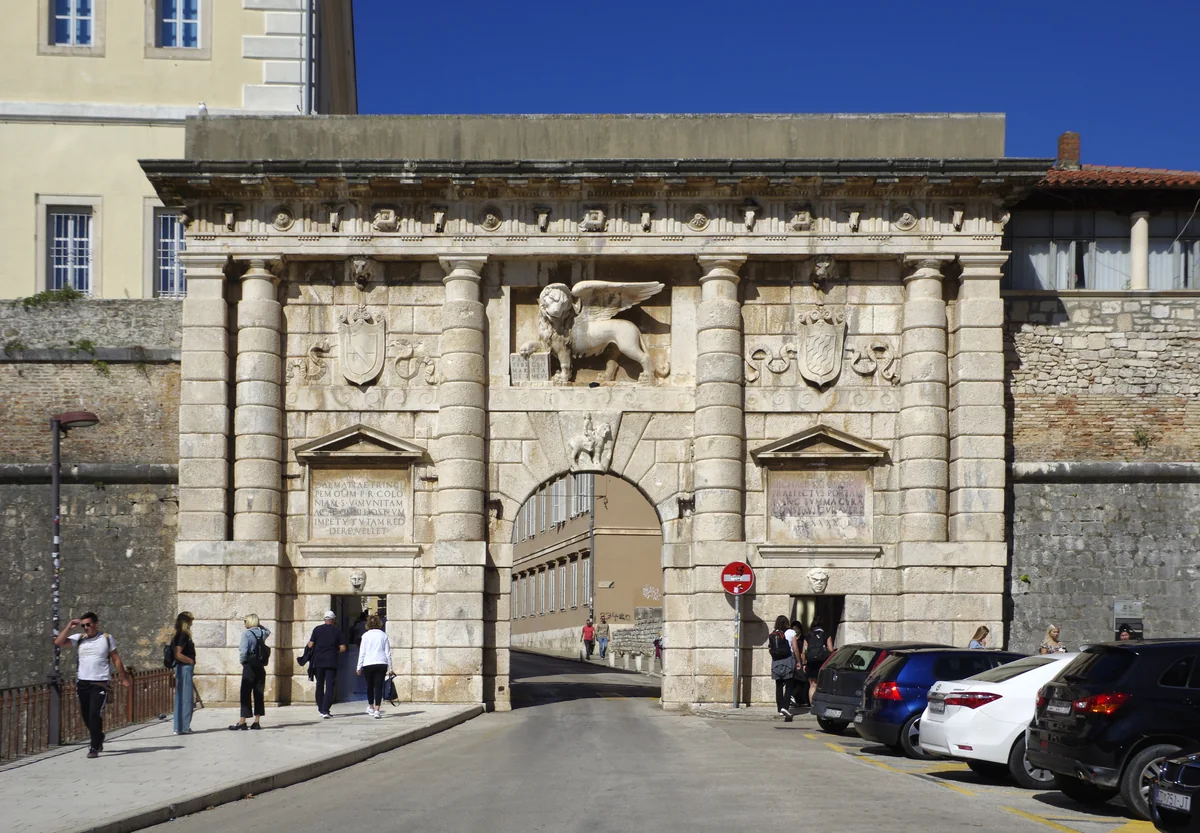

Land Gate: begin at Foša
The Land Gate, or Kopnena vrata, was built in 1543. Its Renaissance composition frames a large central arch and smaller pedestrian openings. Above them, look for St Chrysogonus on horseback and the winged lion of St Mark, a symbol of the Venetian Republic. The setting beside Foša harbour makes this a natural beginning for a walk into the peninsula.
Sea Gate: a different story
The Sea Gate stands between the harbour and city market. Built in 1573 to commemorate the victory at Lepanto, it incorporates parts of an earlier Roman arch associated with Melia Aniana. It is also called the Gate of St Chrysogonus. Visit both gates if you want to see how civic memory, reused stone and Venetian power overlap; they are not two names for the same entrance.
What the UNESCO listing actually covers
Zadar’s defensive system forms part of the transnational Venetian Works of Defence World Heritage property, inscribed in 2017. The listing does not make every building on the peninsula individually UNESCO-listed. The walls known as Muraj now also serve as a promenade. Read the fortifications as a connected defensive landscape rather than a sequence of isolated photo stops.
Plan the approach
Allow 15–20 minutes for the Land Gate and Foša as an editorial starting estimate, longer if you continue around the walls. Use pedestrian openings and stay aware of vehicles near the approaches. The mapped route runs roughly 120 metres from the Land Gate waypoint to Five Wells Square. That short connection includes changes of level; visitors needing a step-free itinerary should check an alternative locally.
Reference: Zadar Tourist Board · City walls · UNESCO · Venetian Works of Defence · Zadar Tourist Board · Foša
Kopnena vrata = Land Gate; Morska vrata = Sea Gate. The Land Gate is at Foša, while the Sea Gate is beside the harbour and market.
Reviewed 19 September 2026