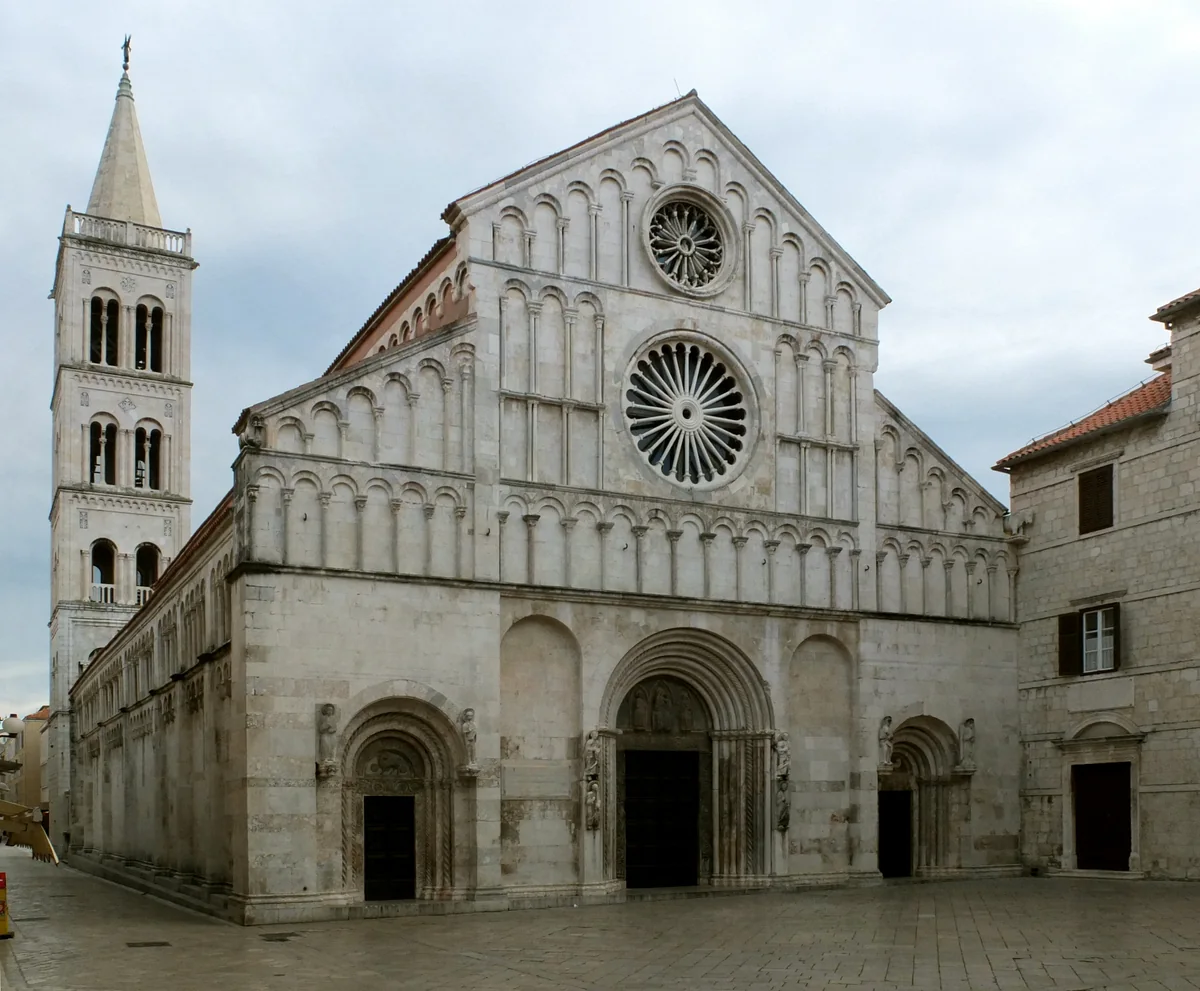

A Romanesque cathedral with older roots
The building largely belongs to the twelfth and thirteenth centuries, but its site reaches back through earlier churches to an early Christian basilica. It was first associated with St Peter. After Bishop Donatus brought the relics of St Anastasia to Zadar in the early ninth century, the dedication changed. The Croatian name Stošija and the English Anastasia identify the same saint.
Give the façade its own moment
Before entering, stand back far enough to read the whole front: the two rose windows, layered arcades and portals reward more attention than a hurried photograph allows. Then compare its ordered surface with the powerful curved mass of St Donatus nearby. The two buildings are close together but offer very different ways of understanding medieval architecture.
Worship, visiting and the bell tower
This is an active cathedral. Services and religious occasions take priority over sightseeing; follow posted instructions, dress respectfully and avoid interrupting worship. Treat a bell-tower climb as a separate decision with its own access and admission arrangements. Ask about current opening and tickets locally instead of assuming the church, tower and adjoining heritage sites share one timetable.
Address and accessibility
The tourist board lists the cathedral at Trg sv. Stošije 2, with telephone +385 23 251 708. Allow around 20–30 minutes for a church visit, excluding a tower climb or service. Its accessibility guide describes a ramp at the southern side entrance but warns that the door may be closed and assistance needed. Contact the cathedral in advance if step-free access is essential; the tower should not be treated as step-free.
Reference: Zadar Tourist Board · St Anastasia · Zadar Tourist Board · Accessibility
The cathedral and St Donatus are separate buildings. Use the Croatian name Katedrala sv. Stošije when asking for directions or checking local signs.
Reviewed 19 September 2026