
Picture a working Roman centre
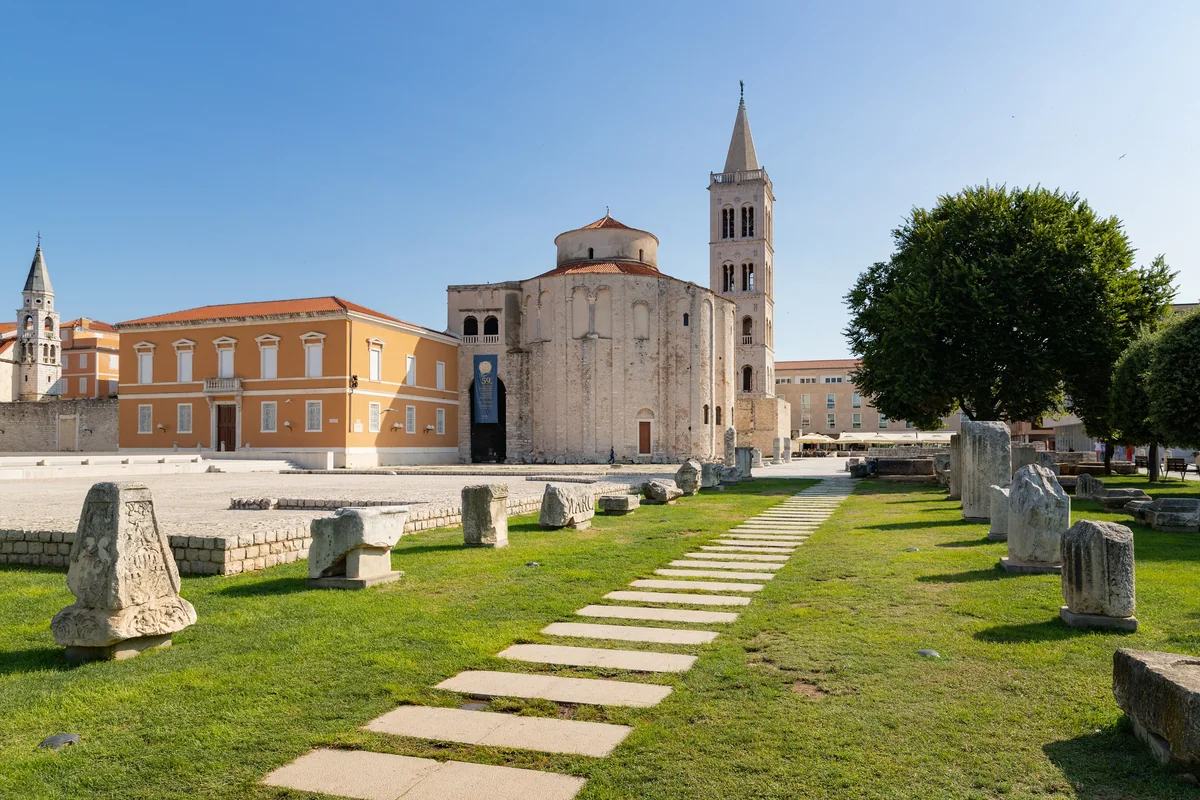
The Forum’s origins reach back to the first century BC. In antiquity this was a civic, religious and commercial meeting place, bordered by porticoes and shops. Today’s open setting is easier to appreciate if you first imagine those enclosing structures. The surviving fragments belong to a once organised urban space, rather than an outdoor collection assembled simply for display.
Read the edges before the details
Start with the outline of the square, then look at column fragments, paving and changes in level. Turn towards St Donatus to see how later builders occupied the Roman setting. The Archaeological Museum nearby supplies the missing context through objects recovered from Zadar and the wider region. For a first visit, this pairing is more informative than trying to identify every loose fragment independently.
Leave room for an ordinary square
The Forum is part of the contemporary city as well as an archaeological place. People cross it, meet beside it and continue towards the waterfront. Allow 20–30 minutes as a suggested starting point, longer if you combine it with a museum or church. Softer light can make the stonework easier to read; shade is limited in the open areas.
Access and the next stop
There is no general admission gate to the outdoor square; the surrounding interiors have their own rules and tickets. Surfaces and levels vary. The tourist board identifies an accessible paved area but notes that the lower archaeological level has no ramp. Stay on permitted paths and avoid climbing ancient remains. Our mapped walk continues about 520 metres from the Forum waypoint to the Sea Organ.
Reference: Zadar Tourist Board · Forum · Zadar Tourist Board · Accessibility · Arheološki muzej Zadar · hours & tickets
The Forum, St Donatus, the cathedral and the Archaeological Museum are distinct places. A ticket for one interior does not automatically cover the others.
Reviewed 19 September 2026